


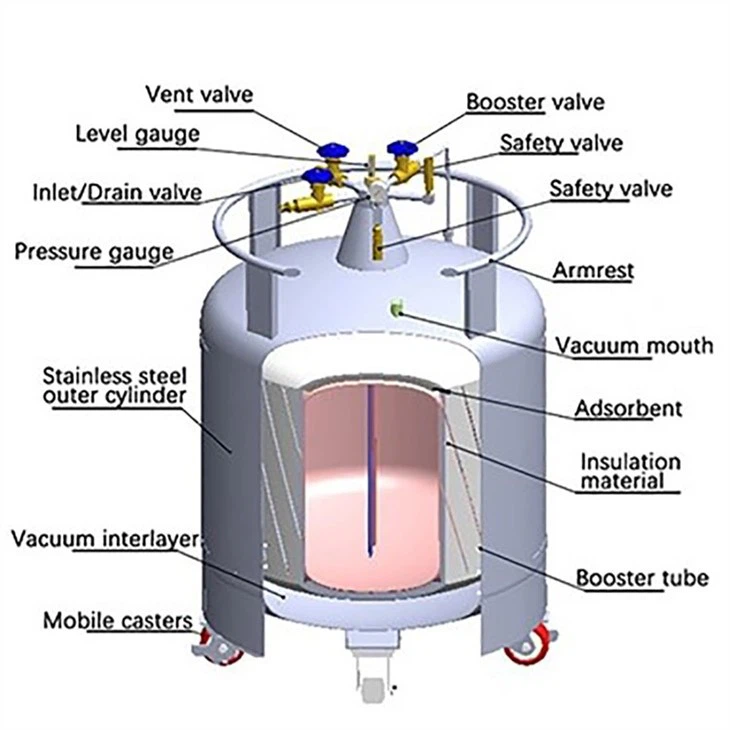

Liquid Helium Dewar Cylinder
Dewars are mainly used to store and transport liquid oxygen, liquid nitrogen, liquid argon and liquefied natural gas. The gas cylinder is designed as a double-layer (vacuum) structure. The inner box is used to store cryogenic liquids.
- Fast Delievery
- Quality Assurance
- 24/7 Customer Service
Product Introduction
|
DPL-375L/410L/450L-1.4 Technical Specification |
|||
|
Product Model |
DPL-375L |
DPL-410L |
DPL-450L |
|
Diameter*Height (mm) |
750*850*1665 |
750*850*1770 |
750*850*1900 |
|
Working Pressure (MPa) |
1.40 |
1.40 |
1.40 |
|
Pressure Relief Valve (MPa) |
1.59 |
1.59 |
1.59 |
|
Inner Container Bursting Disc (MPa) |
2.60 |
2.60 |
2.60 |
|
Maximum Liquid Capacity (L) |
375 |
410 |
450 |
|
Usable Liquid Capacity (L) |
356 |
389 |
427 |
|
Normal Evaporation Rate (LN2) |
≤1.8% |
≤1.8% |
≤1.8% |
|
Tare Weight (Kg) |
210 |
269 |
289 |
|
Max. Filling Quality Oxygen (kg) |
405 |
443 |
487 |
|
Max. Filling Quality Nitrogen (kg) |
288 |
315 |
346 |
|
Max. Filling Quality Argon (Kg) |
502 |
548 |
602 |
|
Max. Filling Quality Natural Gas (Kg) |
147 |
161 |
176 |
Introduction
A liquid helium dewar is a container specifically designed for the storage and transport of liquid helium. It combines the principles of cryogenics and vacuum insulation to maintain the extremely low temperatures required for liquid helium. Our liquid helium dewars are made of high-quality stainless steel and are constructed with a double-wall design with a vacuum space between the two walls. This vacuum space, combined with insulating materials such as fiberglass or foam, minimizes heat transfer, thereby maintaining the low temperature inside the bottle. The inner wall of the dewar is in direct contact with the liquid helium, while the outer wall acts as a protective barrier. To ensure safe and efficient operation, the dewar is also equipped with various features, including a pressure relief valve, filling and exhaust ports, and an insulating sleeve. These accessories help maintain the structural integrity of the bottle and prevent liquid helium leaks.
Advantages
Excellent insulation performance
The liquid helium dewar adopts a double-layer vacuum structure, which greatly reduces the transfer of heat. The low thermal conductivity material filled in the middle, such as pearl cotton or polystyrene, further enhances the insulation effect. During normal use, a high-quality liquid helium dewar can keep the temperature of liquid helium stable for days or even weeks, reducing the evaporation loss of liquid helium due to external heat transfer.
Multiple specifications available: Our three models of liquid helium dewars have a variety of capacity specifications to choose from, such as 375L, 410L, and 450L, which can meet the needs of different users. Whether it is a small amount of liquid helium storage demand in a small laboratory or a large amount of liquid helium demand in large scientific research institutions, industrial production, etc., you can find a suitable liquid helium dewar.
Sturdy structural design
Our liquid helium dewar is made of high-quality stainless steel material, with excellent corrosion resistance and mechanical strength, and can withstand greater pressure and external impact. During transportation, even if it encounters bumps, collisions, etc., the liquid helium dewar can remain intact without damage or leakage.
Complete safety devices
The liquid helium dewar is equipped with a variety of safety devices, such as safety valves, bursting discs, etc. When the pressure in the bottle exceeds the set safety value, the safety valve will automatically start to exhaust and release the pressure to prevent the bottle from exploding due to excessive pressure; if the safety valve fails, the bursting disc will automatically rupture when the pressure rises sharply to a certain level, quickly reducing the pressure in the bottle to atmospheric pressure to ensure the safety of the use process.
Easy to operate
The control valve group and filling connector of our liquid helium dewar are generally installed on the top of the tank for easy operation. And it can be connected to various standard sizes of hoses, which is convenient for connection and use with other equipment. Whether it is filling or outputting liquid helium, it only takes simple operating steps to complete.
Adapt to a variety of application scenarios
Our liquid helium dewar can be widely used in scientific research, medical care, industry and other fields. In scientific research, such as low-temperature physics experiments and material science research, liquid helium dewars provide a stable low-temperature environment for experiments; in the medical field, such as magnetic resonance imaging equipment, liquid helium dewars are the cooling medium for superconducting magnets; in the industrial field, they can be used for low-temperature testing and processing in semiconductor manufacturing, aerospace and other industries.
Application
Magnetic resonance imaging (MRI):
Liquid helium dewars are the cooling medium for superconducting magnets in MRI equipment. Superconducting magnets are able to generate strong and stable magnetic fields when cooled by liquid helium, which are used for imaging human tissue. MRI technology is widely used in disease diagnosis, medical research and other fields, and the reliability and stability of liquid helium dewars are essential to ensure the normal operation of MRI equipment.
Semiconductor manufacturing:
During semiconductor manufacturing, some processes need to be carried out at extremely low temperatures. For example, when manufacturing high-purity silicon wafers, liquid helium dewars can be used to cool reactors, control reaction temperatures, and improve product quality and production efficiency.
Aerospace engineering:
In aerospace engineering, liquid helium dewars are used to test and simulate spacecraft components. Cryogenic testing is essential for evaluating the performance of materials and systems under extreme conditions similar to those encountered in space. Dewars ensure that liquid helium is available for these tests, allowing engineers to collect valuable data and optimize the design of future missions.
Cryogenic physics research:
In condensed matter physics, the quantum properties of matter at extremely low temperatures are studied, such as superconductivity, superfluidity, etc. Liquid helium dewars provide a stable, extremely low temperature environment, allowing scientists to conduct in-depth studies of phenomena such as quantum phase transitions and quantum Hall effects in materials. For example, when studying superconducting materials, the extremely low temperature of liquid helium can cause the material to enter a superconducting state, thereby measuring its superconducting properties, such as critical temperature and critical magnetic field.
Frequently Asked Questions
1. What are the main materials used in making liquid helium dewar cylinders? Why choose these materials?
The main materials used to manufacture liquid helium Dewars include high-strength stainless steel or aluminum alloys for the outer and inner walls, as well as insulating materials such as fiberglass or foam. These materials were chosen for their durability, resistance to low temperatures, and ability to maintain a vacuum seal.
2. How does vacuum insulation work in a dewar cylinder? What role does it play in maintaining liquid helium?
Vacuum insulation in a Dewar works by eliminating most heat transfer mechanisms (mainly convection and conduction). The vacuum space between the inner and outer walls minimizes heat transfer, allowing liquid helium to remain at its boiling point for extended periods. This insulation is critical to maintaining the extremely low temperatures required for liquid helium storage.
3. How does the size of a liquid helium dewar cylinder affect its performance and efficiency?
The size of a liquid helium Dewar significantly affects its performance and efficiency. Larger cylinders offer greater storage capacity, but may also require more insulation and more complex vacuum systems to maintain cold temperatures. Conversely, smaller cylinders may be more efficient but have limited storage capacity.
4. What safety measures can you take to prevent accidents or leaks from liquid helium dewar cylinders?
Safety measures for liquid helium Dewars include pressure relief valves, rupture discs, and leak detection systems. These features help prevent overpressure and detect any potential leaks, ensuring the safe operation of the cylinder. Additionally, proper handling and storage procedures, such as using protective equipment and placing cylinders in well-ventilated areas, are critical to preventing accidents.
5. What is a liquid helium dewar cylinder?
A liquid helium dewar cylinder is a container used to store and transport liquid helium. It is usually composed of a double-layer or multi-layer structure with good insulation properties to prevent the liquid helium from evaporating too quickly. The liquid helium dewar cylinder is designed to provide a safe and reliable environment to preserve liquid helium, a cryogenic liquid that plays a key role in many scientific research and industrial applications.
6. How does a liquid helium dewar cylinder work?
The liquid helium dewar cylinder uses multi-layer insulation technology to reduce the transfer of heat. Usually, it contains an inner tank and an outer tank, filled with insulation materials such as vacuum, multi-layer reflective materials, etc. These insulation layers effectively prevent external heat from entering the inner tank, thereby maintaining the cryogenic state of the liquid helium. In addition, the liquid helium dewar cylinder is usually equipped with a pressure relief device to prevent the internal pressure from being too high.
7. How to perform daily maintenance of liquid helium dewar flasks?
Daily maintenance mainly includes regular inspection of the appearance of the flask for damage, leakage, etc.; checking whether the safety valve and liquid level monitoring device are working properly; keeping the environment around the dewar flask clean to avoid the accumulation of debris that affects heat dissipation and safety. In addition, when not in use for a long time, the liquid helium should be emptied and the dewar flask should be properly stored.
8. Is the operation of the liquid helium dewar flask complicated?
The operation of the liquid helium dewar flask is not complicated. Before use, it is necessary to ensure that the dewar flask is placed in a stable and well-ventilated position. When connecting pipes and equipment, follow the correct operating procedures to avoid leakage. Generally, a detailed operating manual is provided with the dewar flask. As long as the user follows the manual, the liquid helium dewar flask can be used safely and effectively.
9. Liquid Helium Dewar: How to solve the air leakage problem inside cryogenic equipment?
Air leakage problems in cryogenic equipment are often caused by poor connections between components or worn parts. Therefore, regularly inspecting the equipment to determine whether worn parts need to be replaced or components reconnected is an important step in solving air leak problems.
10. What is the safety performance of the liquid helium dewar?
The liquid helium dewar has multiple safety designs. First, the bottle body is made of high-strength, low-temperature resistant materials, which can withstand the extremely low temperature and pressure of liquid helium. Secondly, it is equipped with a safety valve, which automatically releases the pressure when the internal pressure exceeds the set value to prevent the bottle from exploding. In addition, there is a liquid level monitoring device, which allows users to understand the storage amount of liquid helium at any time to avoid affecting the use or safety hazards due to insufficient liquid helium.
Hot Tags: liquid helium dewar cylinder, China liquid helium dewar cylinder manufacturers, suppliers, factory


